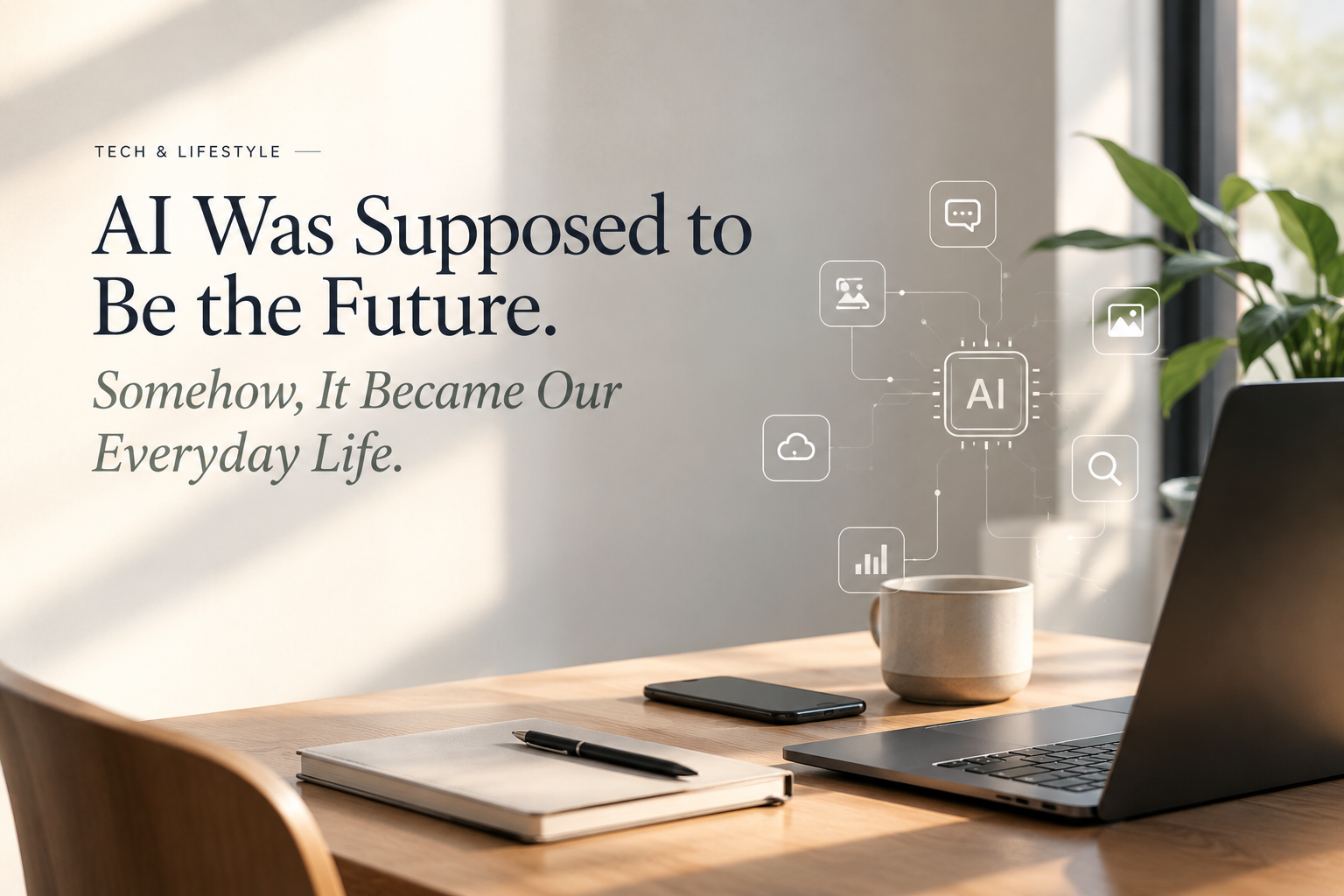
AI Was Supposed to Be the Future. Somehow, It Became Our Everyday Life.
A few years ago, Artificial Intelligence felt like something from a science-fiction movie. We imagined robots, futuristic cities and machines that could think like humans. Today, it feels much less dramatic. We pick up our phones, open an app and use AI and technology without even thinking about it. Your music app recommends a song, Google Maps finds a quicker route, and social media decides what content might interest you. AI didn’t suddenly arrive. It slowly became normal.
When AI Stopped Feeling Like Technology
What I find interesting about AI in everyday life is how invisible it can be. We don’t usually stop and think, “AI is helping me right now.” We simply use the app and move on. But generative AI has changed that relationship. Now we can actually interact with AI tools. We can ask questions, brainstorm ideas, create images, summarize information, write drafts or simply use AI when we’re stuck. Technology isn’t just working somewhere in the background anymore. We’re actively interacting with it.
But Should AI Do Everything for Us?
This is where things get complicated. AI can save us hours, but it can also make us dependent on it. It can give us ten ideas when we’re stuck, but what happens if we stop trying to come up with the first idea ourselves? It can write an entire paragraph, but does that paragraph actually sound like us? And it can give us an answer almost instantly, but should we automatically believe it? I don’t think the answer is to avoid AI. I think it’s about finding a balance between technology and humans.
We can use AI to make our work easier without allowing it to replace our curiosity, creativity and judgment.

How AI and Technology Are Changing Our Everyday Lives
When you think about how AI and technology are changing our everyday lives, the biggest changes aren’t always dramatic. A student can use AI to understand a difficult topic. A small business owner can use AI tools to explore marketing ideas. A designer can use AI to experiment with concepts before creating the final work. Someone who struggles with writing can use AI to organize their thoughts. These may seem like small things, but when millions of people start using technology this way, the way we work and learn begins to change.
The Future Isn’t Really Humans vs. AI
I don’t think the future of AI and technology is simply about AI replacing humans. It will probably be about humans learning how to work with AI. AI can generate an answer in seconds. It can create an image, organize information and help us solve problems. But it doesn’t automatically know what matters to us. It doesn’t know why an idea is important to us or what story we want to tell. That’s still our part.
Maybe That’s the Real Conversation
We spend a lot of time asking what AI will be capable of next. Will it become smarter? Will it change jobs? What new AI tool will appear next? Those are interesting questions. But I think there’s another question worth asking: What are we going to do with the possibilities AI gives us? Because technology can give us answers faster than ever. But it can’t replace curiosity. It can’t replace having your own perspective. And it shouldn’t replace the desire to learn. Maybe the future of AI and technology isn’t about choosing between humans and machines. Maybe it’s about learning how to use powerful technology while still staying completely human. AI can help us create. But the reason we create is still human.