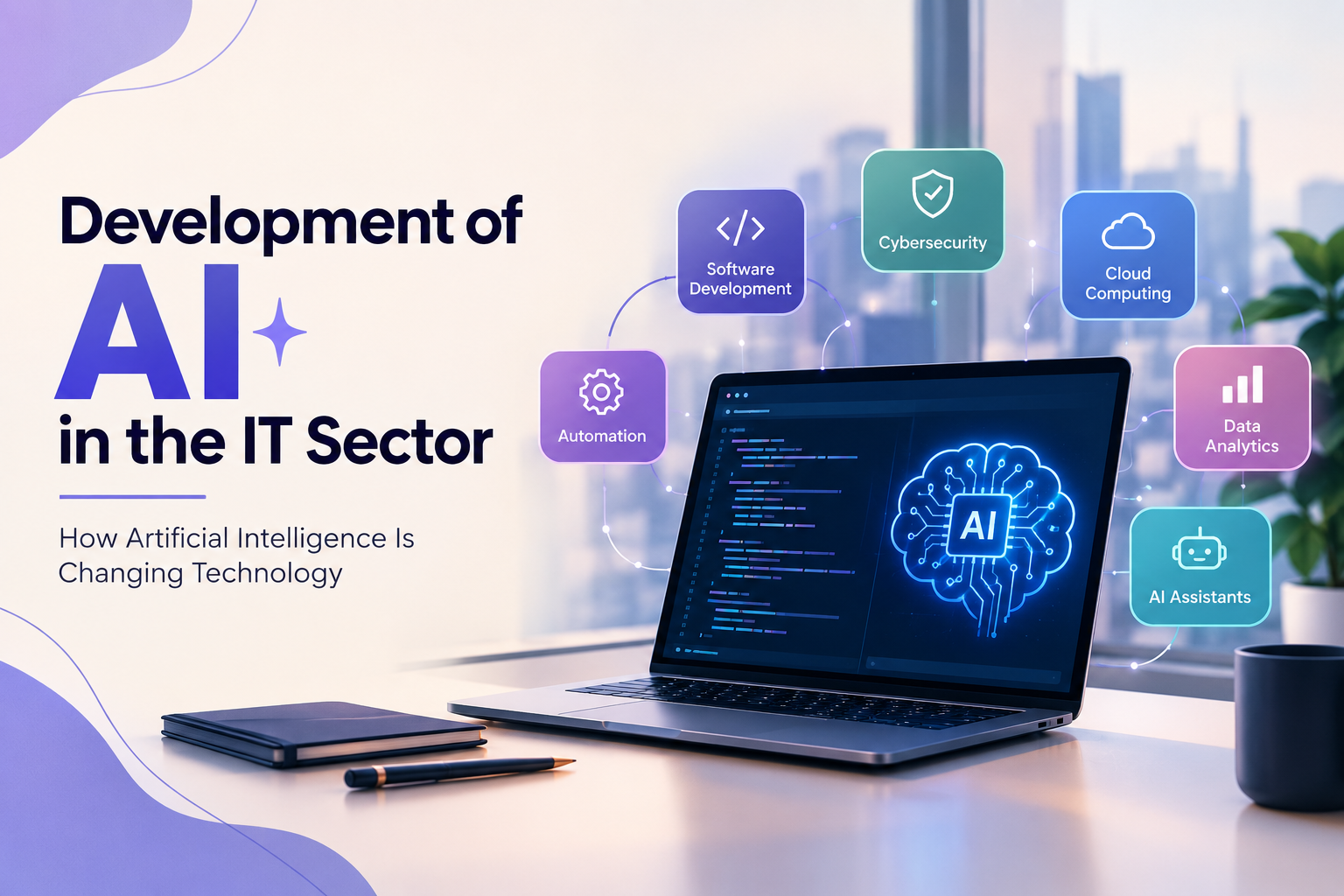
Development of AI in the IT Sector: How Artificial Intelligence Is Changing Technology
Artificial Intelligence has moved from being a futuristic concept to becoming an important part of the technology industry. From automating repetitive tasks to helping businesses make faster decisions, AI development in the IT sector is changing the way technology is created, managed, and used.
Today, IT companies are increasingly adopting AI tools to improve productivity, cybersecurity, software development, customer support, and data analysis. As AI technology continues to develop, its role in the IT industry is expected to become even more significant.
What Is AI Development in the IT Sector?
AI development in the IT sector refers to the use and development of artificial intelligence technologies to improve IT services, software, systems, and business processes.
AI systems can analyse large amounts of information, identify patterns, understand natural language, and perform tasks that traditionally required human effort. Technologies such as machine learning, natural language processing, computer vision, and generative AI are becoming increasingly common across the IT industry.
The Growth of AI in the IT Industry
One of the biggest developments in recent years has been the rapid adoption of AI in the IT industry. Companies are using AI not only for customer-facing applications but also for internal operations.
For example, AI-powered systems can monitor networks, detect unusual activities, predict system failures, and automate routine IT tasks. This allows IT professionals to focus more on complex problems and strategic work.
The growth of generative AI has further accelerated this development. AI tools can now assist with writing code, creating documentation, analysing information, generating content, and answering technical questions.
How AI Is Transforming Software Development
One of the most visible applications of AI is in software development. AI in software development can support developers throughout different stages of the development process.
AI-powered coding assistants can suggest code, identify errors, explain programming concepts, and help developers complete repetitive coding tasks. AI can also assist with software testing by identifying potential bugs and suggesting test cases.
This does not mean that AI completely replaces developers. Instead, it acts as a support system that can help developers work more efficiently and spend more time on problem-solving, creativity, and system design.
AI and Automation in IT
AI automation is another major area of development within the IT sector. Many repetitive IT activities can now be automated using intelligent systems.
Tasks such as system monitoring, ticket classification, password-related support, data processing, and routine troubleshooting can be handled partially or completely through AI-powered systems.
This can reduce manual workload and improve response times. Businesses can also operate more efficiently because employees can focus on tasks that require human judgement and creativity.
The Role of AI in Cybersecurity
As cyber threats become more sophisticated, organisations are increasingly exploring AI in cybersecurity.
AI systems can analyse large volumes of network activity and identify unusual patterns that may indicate a security threat. Machine learning models can help detect suspicious behaviour, identify potential attacks, and support security teams in responding to incidents.
However, AI is also being used by cybercriminals to create more sophisticated attacks. This means that the development of AI creates both opportunities and challenges for cybersecurity professionals.
AI in Cloud Computing and IT Infrastructure
Another important area is the combination of AI and cloud technology. AI and cloud computing are being used together to process large amounts of data and provide intelligent services at scale.
Cloud platforms allow businesses to access powerful computing resources without having to maintain all the required infrastructure themselves. AI can then analyse the information processed through these systems and provide predictions, recommendations, and automated solutions.
This combination is helping businesses build more flexible and intelligent IT environments.
Benefits of AI Development in the IT Sector
The increasing adoption of AI provides several benefits to IT companies and businesses:
Higher productivity: AI can automate repetitive tasks and reduce manual work.
Faster decision-making: AI can analyse large amounts of data quickly.
Improved customer support: AI-powered chatbots and virtual assistants can provide faster responses.
Better cybersecurity: AI can identify unusual patterns and potential threats.
Reduced operational costs: Automation can reduce the time required for routine processes.
Improved software development: AI tools can assist developers with coding and testing.
24/7 operations: AI systems can continuously monitor systems and processes.
Challenges of AI in the IT Sector
Despite its benefits, AI technology in IT also comes with several challenges.
One major concern is data privacy. AI systems often require large amounts of data, making responsible data management extremely important. Companies must ensure that sensitive information is properly protected.
Another challenge is the possibility of inaccurate AI-generated information. AI systems can sometimes produce incorrect or misleading results, so human supervision remains important.
There are also concerns about job roles changing because of automation. While AI may reduce the need for certain repetitive tasks, it is also creating demand for professionals with skills in AI, data science, cybersecurity, machine learning, and AI management.
What Is the Future of AI in IT?
The future of AI development in the IT sector is likely to involve deeper integration between humans and intelligent technologies.
AI is expected to become increasingly involved in software development, cybersecurity, cloud computing, data analysis, IT support, and business operations. Instead of simply using AI as an independent tool, organisations are likely to integrate AI directly into their everyday technology systems.
The demand for professionals who understand both IT and AI is also expected to grow. Learning how to work with AI tools, understand AI-generated outputs, and manage AI-driven systems will become valuable skills for IT professionals.
Conclusion
The development of AI is transforming the IT sector at a rapid pace. From AI in software development and AI automation to cybersecurity, cloud computing, and generative AI, artificial intelligence is becoming an important part of modern technology.
AI should not simply be viewed as a replacement for human workers. Its greater potential lies in helping people work faster, solve complex problems, and make better use of technology.
As businesses continue to adopt AI, the IT sector will remain one of the most important areas driving the development and practical application of artificial intelligence.